HISTORY of EDITION OLYMPIA
The OFFICIAL Posters of the
1972 Munich Olympic Games:
the Artist Series and the Sport Series

|
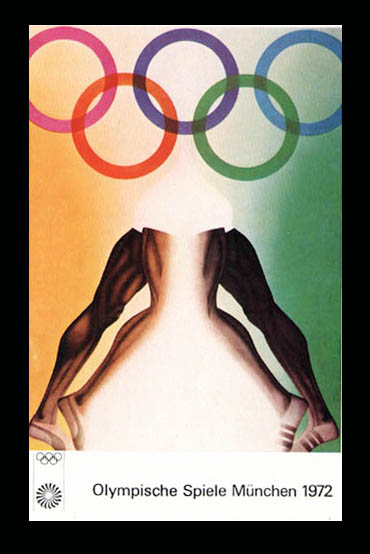
28 posters (color coded yellow below....) The ART (or "Artist") SERIES was an attempt by the Organizing Committee to invite famous artists to express their ideas on the Olympic Games and human movement. Otl Aicher, a German graphic designer, was in charge of the project. |
|
24 posters (color coded rose below....) The SPORTS SERIES posters were used for advertising the Olympic Games and as directional posters. Extra large posters were used as an aesthetic way to direct the public to the various sports venues. The visual image of the sport became the international language to replace German, English and French language signs. Foreign visitors could easily find their way by following the colorful posters that were placed all over the city including bus terminals, train stations and locations near each sport venue. Smaller posters were sold to the general public as a souvenir. |
|
(Editions Olympia 1972 GmbH) This set consists of 28 designs by various famous artists who were selected by the Organizing Committee. HISTORY The Organizing Committee for the 1972 Munich Olympic Games decided to produce a series of artistic posters to "represent the intertwining of sports and art worldwide." Because the financial investment was too much for the Organizing Committee, they decided to form a partnership with a German publisher and formed a new company called Edition Olympia 1972, GmbH -- (translated as: Olympic Editions 1972, Ltd.), which was founded in Munich in 1968. The contract with publisher F. Bruckmann KG gave two-thirds of the profits to the Organizing Committee while Bruckmann kept one third. By the end of 1972 the Organizing Committee had received nearly two million Deutschemarks (2,000,000 DM) from the sale of posters. THE THREE CLASSES of PRINTS and the ORIGINAL 1972 PRICES The original prices of the posters varied due to printing costs. Some posters had more colors than others, and the artist's fees varied. The terminology that the Germans used in the Official Report and publicity brochures referred to three "classes" of posters. This terminology has caused confusion among collectors today because it is different than the terminology used in English. In addition most collectors are not familiar with the graphics arts world and printing techniques. Briefly stated: there is a single piece of art that is the "original" artwork of the artist. This original is rarely sold and would be the most value piece to acquire. The "original" is followed by limited editions that are individually signed and numbered. These are usually limited to only 100, 200 or 300 pieces. In this poster set - it was limited to 200 pieces - all signed and numbered. Then there is another limited edition version that has a signature that is printed within the poster -- it is engraved on the plate (or stone) and printed on the graphic (also called a "print"). And finally there is the "poster" version which is a lithographic or offset print, usually on a different paper than the others. This last version - the "poster" - is also called an "open edition" poster in English and can be printed in large quantities for the publi - tens of thousands of copies. If popular there can even be a second edition of the poster, usually identified by the printer in the lower corners. The "classes" below are the GERMAN terms that were originally used, along with my description
My inventoryThese are all ORIGINAL posters - not reproductions! They were printed in four series in 1970 and 1971. I am always acquiring new inventory and can supply many of the limited edition versions so that most of Class 2 and Class 1 are now available in very limited quanitites. The Official Munich logo - the SPIRALE A 29th poster, the official design of the Munich Olympics entitled SPIRALE, was also produced in a larger format and as of July 2011 is available again in my inventory. In my 1995 Catalog 14 I incorrectly identified this poster as part of the ART SERIES because of the way it was advertised in the USA. In truth it was designed as the official symbol of the Munich Olympics. I have also been informed -- by a member of the artist team that assisted Otl Aicher -- that the Spirale was never offered to the public for sale. But I think he meant in Germany because a poster was printed for the USA market in a limited edition of 3,000 prints. 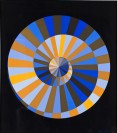 The STORY BEHIND the LOGO and GRAPHICS PROGRAM The story behind the entire graphics program is quite fascinating! It was a lengthy and demanding effort for many artists in creating a logo design. Otl Aicher was the design commissioner for the Organizing Committee. He originally submitted his design of a "wreath of rays" in September 1967. The Organizing committee did not like it and instructed Aicher to make alternative designs, which he did. By November 1967 the Organizing Committee still did not like his submissions and they decided to have a competition for the logo. The competition was then opened to all German artists. By April 1968 there were 2,332 designs submitted and they were all rejected. On May 8, 1968 the committee went back to Aicher's original designs and chose an alternative - his wreath of rays within a spiral. The design by Otl Aicher was refined by another graphic artist, Coordt Von Mannstein of Koln who used a mathematical concept to make it a three dimensional optical illusion. 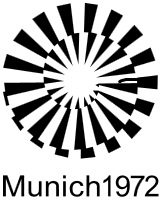 The design was then further refined - in color - by Victor Vasarely, and is frequently mis-identified as a Vasarely piece in art literature. This symbol was then used on all Munich Olympic publications and ads. In addition to the Spirale design, Aicher created the numerous pictograms used for each sport. Aicher also selected the color scheme of muted pastels with the intention of not using any colors that were previously in the National Socialist (Nazi) flag from the World War II era. The colors red and black are nowhere to be found in the 1972 Munich Olympic designs. MEASUREMENTS: All ART SERIES posters measure 25 x 40 inches. CONDITION: All posters offered are in near mint condition. This means that the posters are as close to new as they can be, but keep in mind that they have been moved from Munich to Berlin, where I lived from 1982-1987, then onward to the USA and into my warehouses over a period of several years. So -- they have been touched, rolled, unrolled, stacked, etc. The posters are presently stored flat but are shipped to you rolled in tubes. MY PRICES: My price range is $45.00 to $ 95.00, with 11 posters priced over $100.00. The complete set of 28 posters listed above is valued at approximately $ 2,900.00. A complete set of the limited edition posters (Class 2) would be worth considerably more. A complete set of the limited edition graphics (Class 1 -- edition of 200) would be worth even more. However -- condition is a major factor in value and can detract from value considerably -- so these values are a simple guide. The artists in this series include: Otl Aicher - Serge Poliakoff - Hans Hartung - Marino Marini - Oskar Kokoschka - Charles Lapicque - Jan Lenica - Fritz Winter - Horst Antes - Shusaka Arakawa - Eduardo Chillida - Victor Vasarely - Piero Dorazio - Pierre Soulages - Otmar Alt - Josef Albers - Allen Jones - Allan D'Arcangelo - David Hockney - Valerio Adami - Tom Wesselmann - R.B. Kitaj - Richard Smith - Max Bill - Jacob Lawrence - Alan Davie - Peter Philipps - Paul Wunderlich - F. Hundertwasser PO Box 732 State College, PA USA 16804 email: Olympicbks@aol.com tel: (814) 321-4018 |
2. MUNICH 1972 POSTERS |
|
Payments accepted in US Dollars ($) via: |
|||
| |||
|
I have four (4) pages for the 1972 Munich Olympic Posters |
|
|
~ My History Page of the series known as Edition Olympia You are on this page now! |
|
~ 1972 Munich Olympic ARTIST SERIES POSTERS |
|
~ 1972 Munich Olympic SPORTS SERIES POSTERS |
|
~ 1972 Munich Artist series COMPLETE SET of 29 POSTERS |
|